
Join Us to Shape the Mind Go: What If a Tablet Could Grow into a Desktop?
Updated: Jan 19
Is it possible to make a tiny device as powerful as a workstation?
This question has haunted personal computing for years. We’ve seen Motorola's Lapdock trying to stretch phones into makeshift PCs. Tablets today are starting to adopt laptop-like interfaces. But the fundamental tension hasn’t changed: every step toward higher performance adds mass, heat, and bulk; every push toward lightness strips capability away. As long as everything has to live inside one slab, trade-offs are unavoidable.
How about we take a different path? Rather than asking a single form factor to be everything at once, why not make it modular so it can grow or shrink when you need it to?
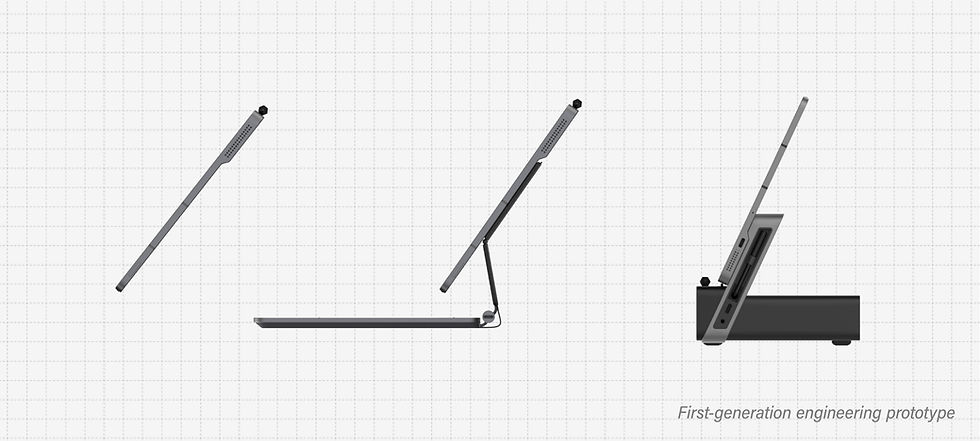
Mind Go is built around this idea. Conceived as a 3-in-1 tablet, it is designed to move fluidly between tablet, laptop, and desktop modes — starting as a portable device, and expanding into a high-performance workstation when docked.
Mind Go's development is already underway, with tangible progress made. But rather than having Khadas make every decision on behalf of our users, we want users to co-create with us and have a direct say in the product’s key aspects. Together, we build something that responds to real workflows and real needs.
In this article, we will explore the design rationale, the current form factors and capabilities, and the direction it’s heading. At the end, you’ll find ways to take part in shaping the Mind Go.
People have long wanted tablets to be more than just tablets
“Way better than a laptop” was the promise Steve Jobs made when introducing the tablet — and the world did fall in love with it. Tablets showed us that being productive doesn’t mean locking yourself to a desk for hours. We could read while lying down, sketch while standing, and easily share our screens with others. Tablets also meant lighter bags, making commuting and traveling much easier.
Yet in many ways, people soon realized that tablets couldn’t catch up with laptops — let alone be way better. Many desktop applications simply don’t run, and operating systems like Android or iPadOS are not capable of serious workloads. As a result, tablets never quite moved beyond reading and entertainment.
Still, people continued to crave more from the tablet. They wanted a device that could be brought onto the desk. This is why Microsoft introduced Surface, a tablet that could become a Windows laptop, finally allowing the tablet to “grow.” The 2-in-1 era began there. But in Khadas’ view, the question Surface tried to answer remains only partially resolved.
From 2-in-1 to 3-in-1: more portable, easier to hold, and radically more powerful
We think that the current 2-in-1 paradigm is an incomplete solution. They are often too cumbersome for comfortable handheld use, yet not powerful enough for demanding desktop tasks. The Mind Go concept tackles this problem head-on with a modular design that supports three distinct modes.
1. Tablet mode: the ultra-portable core
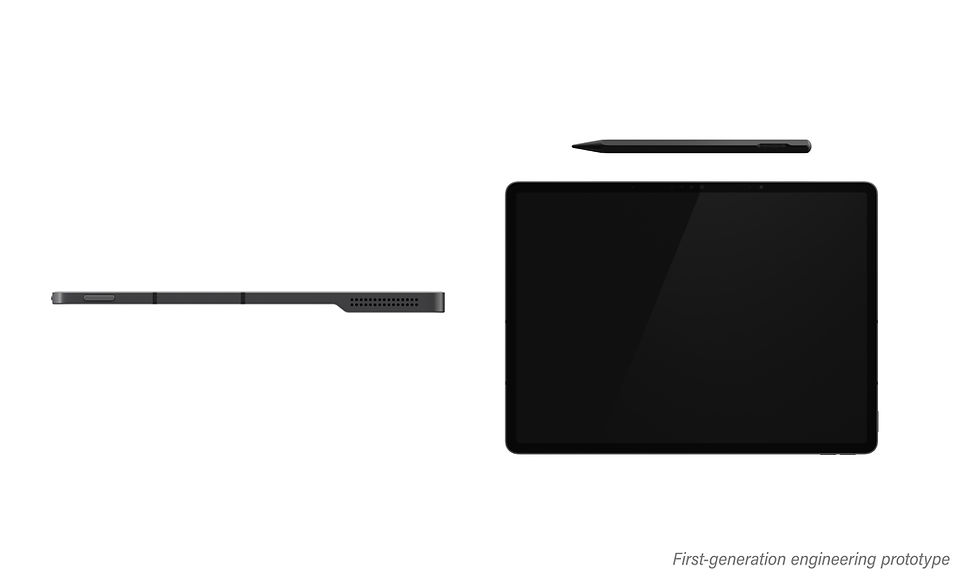
The tablet is a strikingly thin and light 11.6-inch device, weighing around 600g. It features built-in speakers and a front-facing camera and works with the Mind Pencil for handwriting and sketching. An ergonomically raised edge on the back improves one-handed grip.
Compared with most 2-in-1 devices, this form factor is noticeably smaller and thinner. It is light enough to be carried and held effortlessly, yet still large enough for meaningful work. For people who commute frequently and work beyond the desk, 11.6 inches proves to be an ideal size — easy to slip into a bag, comfortable to hold during a presentation, and practical for reviewing documents on the go. The current LCD-based prototype measures approximately 6.1 mm in thickness. Khadas is also evaluating OLED display options, which could bring the thickness down to around 5.5 mm and further reduce overall device weight.

So how does Mind Go achieve such a thin and light form factor? Part of the answer lies in its fanless design, made possible by a highly energy-efficient platform, with the specific chipset still under evaluation. More importantly, Mind Go distributes its battery between the tablet and the keyboard, rather than concentrating it entirely within the tablet. Naturally, this means the tablet on its own does not offer extended battery life. This is a deliberate trade-off. By not forcing the tablet to act as a powerhouse in every scenario, Mind Go makes the tablet core smaller for portability and comfortable handheld use during shorter, mobile sessions.
2. Laptop mode: for focused productivity

When it’s time for serious input, Mind Go can be docked into the keyboard with trackpad support. The keyboard is not just an accessory — it is also a battery. Power is delivered through pogo-pin connectors, ensuring a stable, efficient connection without the need for extra cables. The keyboard brings the total battery capacity to 45 Wh, enabling up to around nine hours of local video playback.

In laptop mode, the tablet can be attached or detached anytime without disrupting what you’re doing. This allows you to shift quickly from seated work to standing presentations, or change postures for standing or walk-around use. This level of freedom is something traditional 2-in-1 devices, with their heavier tablet designs, struggle to offer.
3. Desktop mode: unleashing serious performance

This is where the Mind Go truly diverges.
The Mind Go Stand is an active-cooling base designed to remove the performance constraints of the tablet form factor. With sustained cooling, it allows Mind Go to deliver double the performance compared to its tablet mode.

At the same time, the Mind Go Stand functions as a full-featured desktop dock. It integrates a speaker system along with a wide range of I/O, including USB-C, HDMI, USB-A, Ethernet, and a headphone jack.
Imagine dropping the tablet into the stand and seeing it turn into a multi-display high-performance workstation. You can see how the tablet's own size becomes irrelevant, as it can grow into a full desktop.
Rethinking our workflow
You no longer spend the journey home debating whether you should sync files to a PC — only to give up and continue working hunched over a small screen. Instead, your projects stay with you. When you return home, that same tablet can become a multi-display workstation in moments. Your posture opens up. Your visual space expands. And your ideas explode.

This is not just about solving the portability–performance dilemma that 2-in-1 devices have never fully resolved. It’s about enabling a freer workflow — one that lets your tools adapt to your movement, your space, and the way thinking unfolds.
A genuine invitation to co-create
Here are some of the questions we’re opening up for discussion:
Which platform makes more sense for Mind Go: Snapdragon or Intel? The ARM version offers longer battery life and lower heat output, making it ideal for mobile work, though with more limited software compatibility. The x86 version provides full Windows compatibility and stronger performance, better suited for professional workflows.
Is 11.6 inches the right screen size? The 11.6-inch option is more portable, better for commuting and mobile use, and easier to hold. The 13-inch option offers a larger workspace for extended productivity but may not be able to stay under the current 700 g weight target.
How should the tablet connect to the stand — wired, or via pogo pins? In the current engineering prototypes, Mind Go can receive power and unlock up to 30W of performance through the pogo-pin connection, while full expansion still requires a wired connection.
Should the display be LCD or OLED?
Should the Mind Go Stand offer optional GPU support?
What should we name the Mind Go Stand?
Materials and design of the Mind Go protective case
We will listen carefully to every piece of feedback. And whether you’re voting in quick polls or diving into deeper discussions with our design and engineering teams, we’re glad to have you involved.
Active participants will gain early access to prototypes and follow Mind Go’s development from concept to reality. You’ll be among the first in the world to experience this new form factor.
If Mind Go is the future you’re excited about, join us and have a real say in what your next computer looks like. Visit https://www.khadas.com/mind-go to join the conversation.


I really appreciate the innovative ideas you’re exploring! I’m curious: how do you envision the user experience evolving with this transition from tablet to desktop? Also, could "monkey mart" integrate into this ecosystem smoothly?
The idea of modular computing devices that can seamlessly transition from a portable mobile tablet into a full-featured desktop workstation opens up incredible possibilities for everyday productivity. When I set up a compact mobile office workspace last year using versatile hardware docks and multi-screen connections, finding efficient ways to handle remote hardware purchases and software licenses digitally was a major priority. Managing cross-border software subscriptions and digital assets securely requires reliable payment portals that offer transparent stablecoin conversions. To explore secure purchasing options for digital tokens and stablecoins like USDC, you can Learn More to understand how streamlined digital transactions work. Innovative hardware concepts combined with efficient management tools make modern computing remarkably versatile